Intelligence,
embodied.

Physical AI Platform for Safe Robotics Autonomy

Xolver is a physical intelligence platform providing robotics foundation models, a deterministic enforcement layer, and embedded runtimes for safe, auditable machine operations.

It is designed as an embedded translation device, an edge runtime, and a model layer you can evaluate.

What you get
  • Embedded Device
  • Edge Runtime
  • Model APIs & Weights

In pilots today, production in constrained environments.

Works with standard robotics middleware and industrial controllers.

We start with a technical assessment, then a controlled pilot.
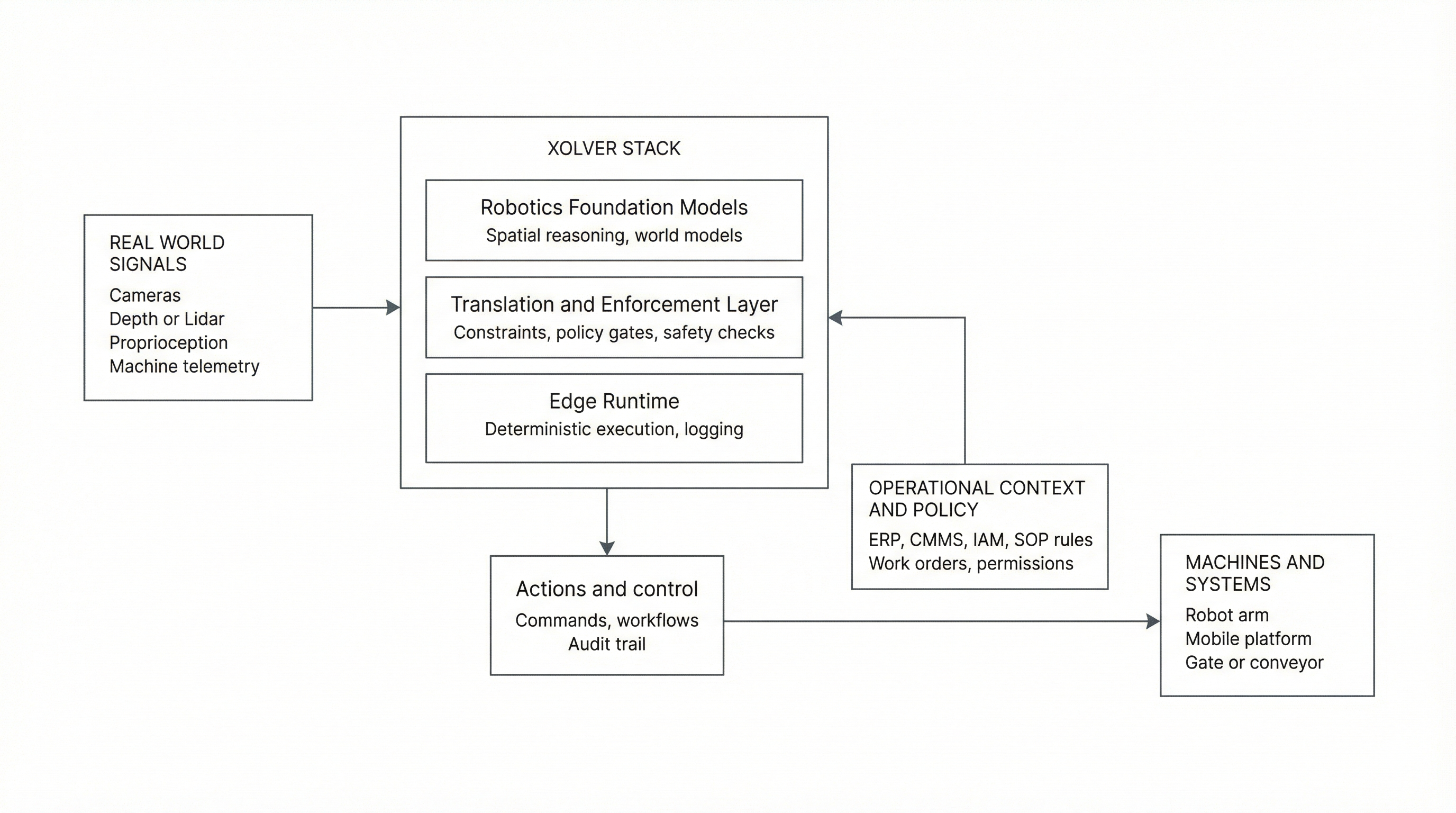
Xolver Control Spine Architecture diagram showing three layers: Robotics Foundation Models, Translation and Enforcement Layer, and Edge Runtime for physical AI systems
NVIDIA Inception Program Member

Industry Partnership

Xolver is a member partner of NVIDIA Inception program that nurtures cutting-edge startups. We leverage the NVIDIA ecosystem to scale our foundation models from research to high-stakes physical environments.

AWS Startups Program Member

Cloud Infrastructure

Xolver is supported by the AWS Startups program, leveraging AWS Activate credits and benefits under the Activate Portfolio. This enables us to build and scale our high-performance robotics infrastructure with enterprise-grade cloud services.

Why Xolver

Why this architecture exists.

Physical systems do not fail because perception is useless. They fail because interpreting the world is not the same as deciding what a machine is allowed to do next.

The hard problem is not generating intent. It is turning intent into physical behavior without losing safety, policy, or control.

Core Principle

What bounded autonomy means.

Bounded autonomy is a design principle for physical systems. Learned models can interpret, adapt, and propose, but physical action remains governed by explicit limits.

That keeps autonomy useful under real operating conditions instead of depending on ideal scenes, perfect connectivity, or unchecked model confidence.

Overview

Infrastructure for physical autonomy.

Models propose, enforcement constrains, runtime executes. Xolver separates these roles so perception, validation, and execution do not collapse into a single unchecked loop.

Where ERP Fits

ERP and IAM feed policy and permissions, not perception.

  • Models output world state & task intent
  • Enforcement outputs allowed actions
  • Runtime outputs execution traces

AI has moved from screens to machines.

Large language models and vision-language models changed what machines can understand. They made planning, interpretation, and adaptation far more capable than traditional software allowed.

What they did not solve is the final step: how a physical system should act safely once intent has been inferred.

What breaks in the wild.

  • Sensor noise
  • Edge latency
  • Intermittent networks
  • Unsafe intent
  • Occlusion and state uncertainty
  • Blocked routes and changing traffic
  • Tolerance drift and environmental variance
Concrete Example

How the stack behaves in practice.

A warehouse vehicle is asked to move inventory to a staging zone while avoiding a restricted area and adapting to a blocked aisle.

1. Model interprets

The system forms a view of the world state, tracks the obstruction, and proposes a new route aligned to the task intent.

2. Enforcement checks

Candidate routes are validated against traffic rules, restricted zones, kinematic feasibility, and safety policy.

3. Runtime executes

The allowed action is executed locally with bounded latency and continuous monitoring against intent and drift.

4. Failure stays bounded

If no safe route exists, the system refuses, logs the reason, and escalates instead of improvising an unsafe move.

What changes with Xolver.

Without Xolver

  • Brittle scripts
  • Fixed tracks
  • Manual reprogramming
  • No auditability

With Xolver

  • Bounded actions
  • Safe refusal
  • Local autonomy
  • Logged execution
Measured on pilots: refusal rate tracked, violation rate tracked, latency budget enforced.
Auditability

What becomes auditable.

Auditability means machine behavior can be reconstructed and reviewed, not just observed in the moment. The system records how intent was interpreted, what actions were permitted, and how execution unfolded.

This gives operators and integrators a usable record of machine decisions instead of leaving critical behavior trapped inside opaque model output.

  • Task intent and world-state interpretation
  • Allowed action versus rejected action
  • Refusal and escalation events
  • Execution traces and timing context
System Fit

How Xolver fits.

Xolver sits between learned perception and physical actuation. It works with robotics middleware, industrial controllers, and existing operational systems rather than replacing the surrounding stack.

That lets teams introduce stronger intelligence and control boundaries without rebuilding everything around the machine.

  • Works with robotics middleware and controllers
  • Connects policy and permissions to physical behavior
  • Preserves human oversight where it matters

Built for teams where failure is expensive.

Robotics OEMsSystem integratorsEnterprise OperationsRobotics platform teams

CTO Robotics • Head of Automation • Plant Ops • Systems Integrator Lead

Deploy autonomy with boundaries.

We start with a technical assessment, then a controlled pilot.