Physical intelligence for industrial work
Let intelligent machines take over.
Start talking to the robot and deploy new tasks in minutes.
Xolver lends intelligence layer to industrial robots that helps them communicate, learn, predict, recover like a human would.


Task - Observe the red ball trajectory and follow it by predicting where it'd be next
What Xolver enables
Six things a machine couldn't do before.
Talk
Tell the machine what you want in plain language.
"Inspect these connectors and separate anything damaged."
Show
Demonstrate the task, show examples, point out outcomes, or correct what it did.
See
Give the machine an understanding of objects, scenes, positions, people, and changes around it.
Remember
Retain task context, operating history, previous outcomes, and site-specific knowledge.
Predict
Forecast likely outcomes before acting, so risky or uncertain moves can be reviewed first.
Reason
Understand what is happening, predict what may happen, and choose an appropriate action.
What Xolver changes
Yesterday, automation stopped at the edge of variability.
With Xolver, robots can take on the work around it.
Works with these existing robot families and more









From automation project to use-case workflow
A new use case. A changing line. Minutes to hours.
01
Scope
Start with the use case, line constraints, parts, downtime pattern, and success criteria.
02
Connect
Connect the robot, controller, sensors, and Xolver Nerve to the existing cell.
03
Teach
Describe the work, demonstrate examples, and define what good outcomes look like.
04
Verify
Establish operating boundaries, safety constraints, and review points before movement.
05
Deploy
Run the workflow. Monitor exceptions. Recover faster. Improve from what happens.
Qualify parts and separate defects without rebuilding the workcell.
Pick, place, and stack variable items from plain-language goals.
Group known parts, isolate unknowns, and keep the cell moving.
Respect workspace boundaries while adapting to live scene changes.
Apply careful tactile effort where scripted motion is too brittle.
Qualify parts and separate defects without rebuilding the workcell.
Pick, place, and stack variable items from plain-language goals.
Group known parts, isolate unknowns, and keep the cell moving.
Respect workspace boundaries while adapting to live scene changes.
Apply careful tactile effort where scripted motion is too brittle.
Use robots in places they could not reliably work before
Bring intelligence to machines.
Start with inspection, sorting, handling, tending, or recovery workflows that are too variable for brittle automation. Add Xolver so the cell can understand the work area, adapt to changes, and keep operators in the loop.
Proprietary technology stack
Autonomy without the all-or-nothing bet
Autonomous when it can be. Human-controlled when it needs to be.
01
Autonomy
The machine executes the task on its own.
02
Uncertainty
Xolver detects that confidence has fallen or the situation requires intervention.
03
Safe pause
The robot enters a controlled state. Nothing moves until a decision is made.
04
Teleoperation
An operator remotely inspects the situation and takes direct control of the robot to resolve the exception.
05
Resume
Once the exception is resolved, the robot returns to autonomous operation.
Use cases that improve together
One use case improves. Other cells benefit.
1
Use case
Prove the workflow on one hard-to-automate industrial problem.
1
Line
Apply the lessons to the cell, operators, exceptions, and review process around it.
Many
Cells
Reuse teaching, evidence, and recovery patterns across similar operations.
∞
Installed base
More existing robots and machines become useful as experience accumulates.
Xolver Nerve
Edge intelligence near industrial cells.
Runs near the machine. Connects sensing and skills. Acts as intelligent agent. Feeds Console with evidence. Responds locally, no cloud required.
Xolver Console
Teach workflows. Deploy use cases. Monitor operation.
Xolver Console gives teams the working surface for task teaching, deployment, live monitoring, replay, audit and continuous improvement.
See the Console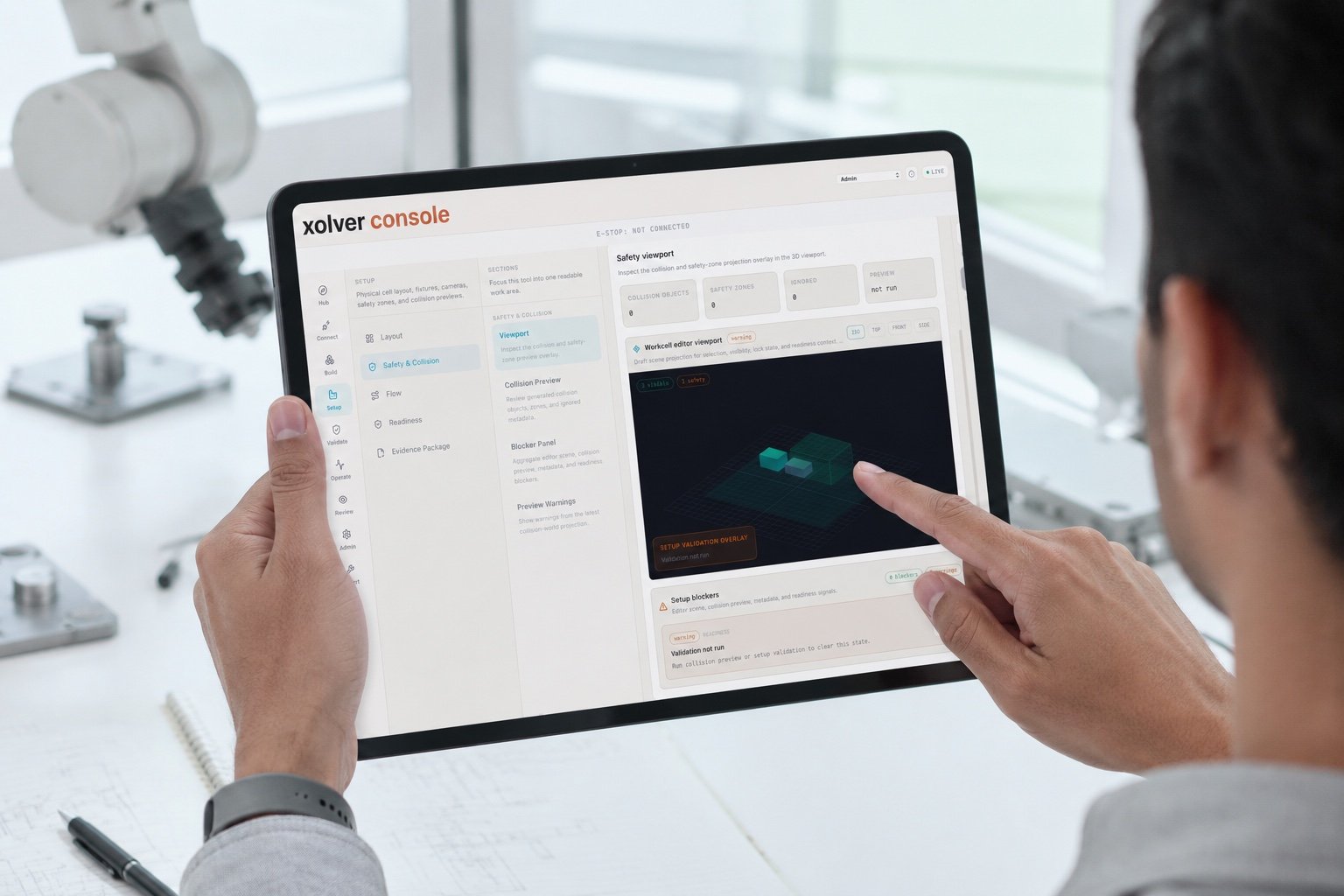
Let's start with something real
Give us one use case. One difficult workflow. One downtime problem.
We'll show you how Xolver scopes the workflow, teaches the robot, deploys intelligence close to the cell, and turns a successful deployment into something you can scale.
Measure what matters
The numbers that tell you whether a use case is working.
Xolver doesn't ask you to trust abstract capability claims. Start with a real industrial workflow, instrument the right metrics from day one, and let the outcomes speak.
Downtime
How often variable work stops the cell and how quickly operators can recover the workflow.
Unplanned stops downChangeover
Time to move a robot from one product variant or operation to another. Minutes not days.
Changeover time downThroughput
How many useful cycles complete per shift after exceptions, variation, and reviews are included.
Output per shift upQuality rate
How often the workflow gets the outcome right without rework, correction, or override.
First-pass yield upIntervention rate
How often the system needs human help and whether that help improves future runs.
Manual touches downRedeployability
How quickly the same cell or machine can take on adjacent industrial work.
Use-case range up